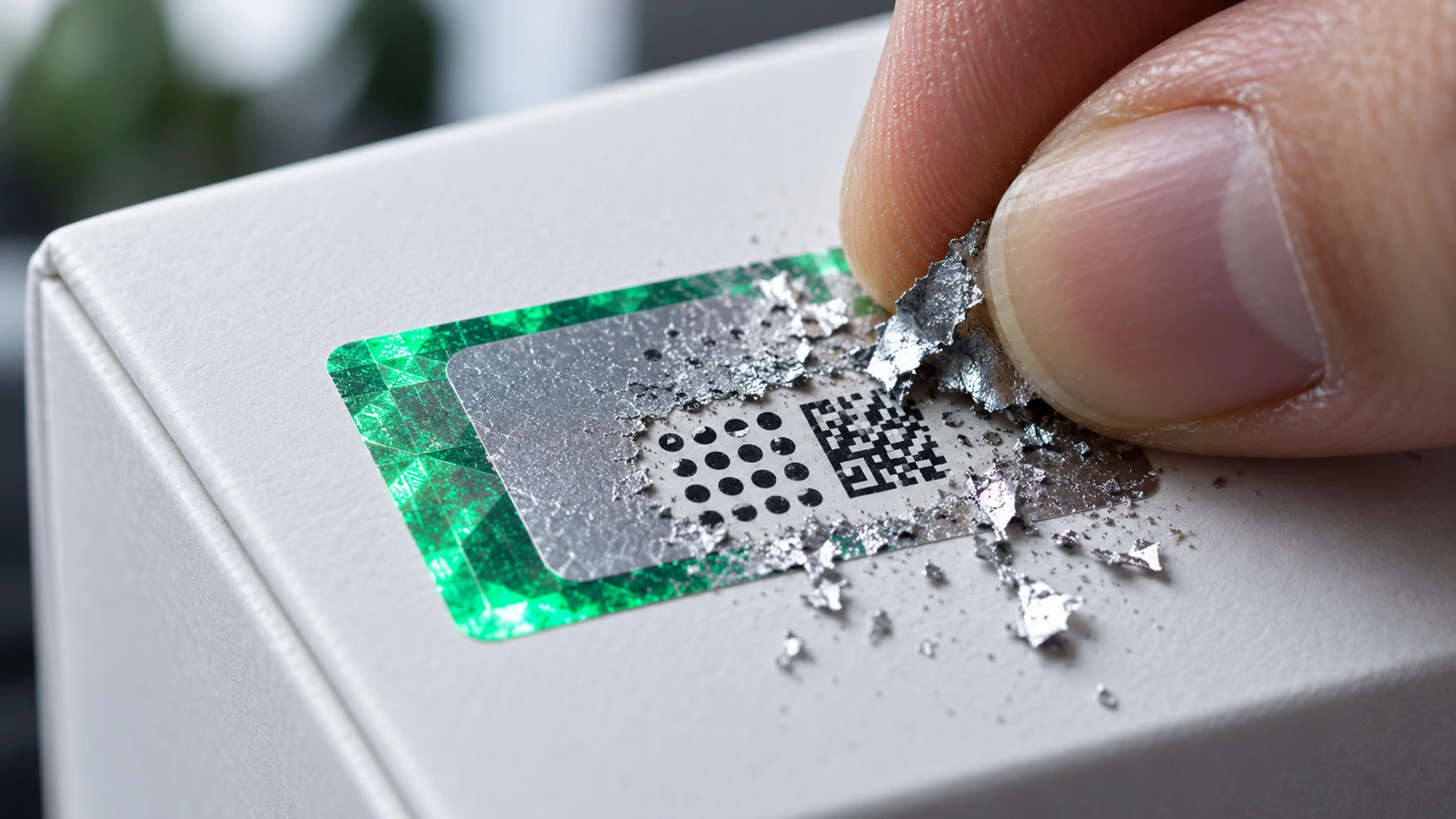
QR Code and Scratch-Off PIN System: An Implementation Guide for Brands
A QR code and scratch-off PIN system pairs a visible digital product identifier with a secret that is intended to remain covered until purchase. The customer scans the QR code, reveals the PIN, and submits it; the platform checks whether both values belong to the same product record and whether that code has a prior-use history.
This is more than placing two marks on a package. Code generation, label printing, stock reconciliation, line application, customer messaging, and suspicious-event review must form one controlled chain. If those handoffs are weak, an impressive label can sit on top of an unreliable process.
What different jobs do the QR code and hidden PIN perform?
The QR code is a machine-readable carrier that helps a phone retrieve a product record quickly. A visible QR image can still be photographed or reproduced on another package. It should therefore not be treated, by itself, as conclusive evidence that the physical item is genuine.
The scratch-off PIN is a concealed value intended to be unavailable before the cover is removed. Requiring both the visible identifier and hidden value makes copying only the QR image insufficient for full verification. The PIN still depends on controlled printing, transport, storage, waste handling, and line use.
| Layer | Purpose | Limit on its own | Evidence to request |
|---|---|---|---|
| QR code | Retrieve the product record | The image can be copied | Item-level record and correct destination |
| Scratch-off PIN | Add a concealed value | It may be exposed in stock or production | Intact cover and controlled consumption |
| System event | Assess code status and use | A signal has little value without review | Time, status, ownership, and closure record |
Where does the verification journey begin and end?
The journey starts before a customer points a phone at the label. It begins when the brand creates an identifier that can be tied to a product family, production order, batch, or individual pack. Its printed, delivered, applied, cancelled, and consumed states need clear definitions.
- Create a product record and unique identifier for each saleable unit in scope.
- Print the matching QR code and PIN under controlled conditions.
- Reconcile delivered, applied, rejected, destroyed, and remaining labels.
- Apply the label where it can be scanned and where the secret remains protected.
- Let the customer scan, reveal the PIN, and submit the verification request.
- Display a useful result and retain an event that the brand can investigate.
The process does not end when a “valid” screen appears. Owners and next actions should be defined for first use, repeat use, incorrect PINs, cancelled codes, and unusual locations. The customer must also have a visible route to support when the result needs context.
Why is item-level identity a foundational decision?
A design that repeats one QR code across every pack can lead customers to a shared information page, but it cannot distinguish the use history of a particular package. Item-level identity moves the question from “what type of product is this?” to “what events have been recorded for this unit?”
GS1's resources on 2D barcodes explain how QR codes can connect a physical product with digital information and carry granular identifiers such as serial numbers. This is general standards guidance, not evidence that any specific xBarkod implementation conforms to a GS1 standard; the brand must design the relationship between its product identity and authentication record.
The PIN is not protected by the scratch layer alone
A PIN should not be easy to guess or submit at scale, and it should not appear unnecessarily in screens, print lists, or operational logs. Buyers should ask how values are created, who can access them, how reprints are controlled, how compromised codes are cancelled, and how verification data is retained.
The online endpoint should not accept unlimited guesses. The OWASP Authentication Cheat Sheet describes attempt throttling and monitoring as controls against guessing attacks. It is not a product-label standard, but its principles are useful when assessing a PIN verification endpoint.
An incorrect-PIN message should help a legitimate customer without revealing unnecessary detail to an attacker. Limits, delays, recovery, and support paths should be chosen according to risk and tested for both abuse resistance and customer usability. “Includes a PIN” is not enough detail for a purchasing decision.
The physical label matters as much as the software
The QR code should be easy to locate and kept away from folds, caps, dense artwork, or glare where possible. The scratch area should stay covered through transport and shelf handling but open without damaging the product. Short instructions should make the order of actions obvious.
Adhesion, removal behaviour, print quality, and scan performance must be tested on the finished package. A sample that works on uncoated board may behave differently on a varnished, curved, chilled, or abrasion-prone surface. The security-label field guide covers the physical pilot in more detail.
Line procedures should cover roll or batch start, restart after downtime, damaged print, torn labels, rework, and end-of-shift reconciliation. Discarding unused or rejected labels without a record creates a gap that software cannot repair.
Which results should the customer experience distinguish?
Customers should not be asked to interpret technical error codes. The experience should distinguish a completed verification, incorrect input, previous use, a cancelled record, and a temporary service problem. Every result should offer a clear next action.
- A way to check product and brand details after a valid first verification
- A careful explanation when the code has a previous-use history
- A retry and support path for an incorrect PIN
- Instructions to retain the package and contact the brand when the event is suspicious
- A later-retry or alternative-support route during a technical interruption
The interface should not automatically declare “this product is counterfeit” merely because a code appears twice. A customer may scan the same item again, a retailer may test it, or a return process may create another event. The system provides a signal; the brand determines what that signal means in context.
How does verification data become action for the brand?
A useful console needs more than an aggregate scan counter. Teams should be able to connect item identity, code status, event time, available location, first and subsequent use, and investigation notes. The contract should state which fields are actually captured and how long they are retained.
A repeat-use event is not proof of counterfeiting on its own. It should be compared with shipping territory, authorised channel, customer contact, and label inventory. The guide on what happens when a QR code is copied explains how to interpret repeated-use signals.
Signals become a backlog if no team owns them. Customer service may handle the first contact, quality or brand protection may assess the product, sales may check the channel, and IT may resolve a system fault. Ownership, response expectations, and closure evidence should be agreed before the pilot.
What should you ask in a vendor evaluation?
Reducing the evaluation to a per-label price hides much of the operating model. The same scope document should cover the code lifecycle, print and delivery, line application, consumer experience, integration, support, data export, and incident review.
- How is the uniqueness and pairing of each product code and PIN controlled?
- Can printed, applied, rejected, cancelled, and wasted codes be distinguished?
- What controls address incorrect PINs and automated high-volume attempts?
- What do the customer and brand see when a code is reused?
- How are label stock and production consumption reconciled?
- Can event records be exported and matched with other operational systems?
- How are roles, access, retention, and support responsibilities defined?
Verify answers with a demonstration, sample record, or contract term rather than a slide. Ask to see negative conditions such as a reprint, cancellation, wrong PIN, repeat use, and temporary loss of connectivity. Operational resilience is easiest to judge at the edges.
How should pilot acceptance be defined?
A pilot is not complete after scanning a few labels and collecting a success screenshot. Use one product family and the finished package to run from code delivery through line use, customer verification, investigation, and closure. Write acceptance criteria for both expected and failed journeys.
- Receive the labels and record totals, samples, rejects, and available stock.
- Observe application, scanning, and scratch-off use on the real line and package.
- Run valid, incorrect-PIN, repeat-use, cancelled-code, and service-error scenarios.
- Confirm that the customer message and brand event describe the same outcome.
- Assign a suspicious event, attach evidence, and close it with an accountable owner.
- Reconcile applied and remaining labels against production.
Base acceptance on scan records, screenshots, inventory reconciliation, investigation records, and named approval—not on a general “it worked” note. A pilot that reveals a gap is still useful because it identifies what must change before broader deployment.
Where does xBarkod fit in this control model?
xBarkod's live product description presents item-specific QR codes, concealed PINs, previous-use checks, consumer verification, and time and location visibility for the brand. Confirm the exact scope against your package, user roles, and event scenarios through a current proposal and pilot.
Start with one product family. Exercise the complete chain from identifier creation and label reconciliation to customer messaging and suspicious-event closure. Carry only the benefits demonstrated in your own operation into the rollout decision. The published Turkish xBarkod overview is the product-source page used for this assessment.
Frequently Asked Questions
How does a QR code and scratch-off PIN system work?
The QR code retrieves the product record, the customer reveals and enters the PIN, and the platform checks whether both values belong together. Code status and prior-use history help determine which result and next action should be shown.
Does a hidden PIN make the QR code impossible to copy?
No. The visible QR image can still be copied. The concealed PIN makes the QR image alone insufficient for full verification. Risk remains if PINs are exposed or label inventory is uncontrolled, so physical and digital controls must work together.
Does every unit need a different QR code and PIN?
Yes, when the goal is to distinguish first and later use for each saleable unit. A shared code can provide general product information but cannot provide item-level use history.
Where should the label be placed?
Choose a position where the QR code scans reliably, the PIN stays covered before purchase, and the customer can find it. Test the actual surface, curve, closure, glare, abrasion, and required packaging information before approval.
Does a second PIN submission prove that the item is counterfeit?
Not automatically. A repeat is a signal that may also result from a customer checking again, a retail test, or a return. The brand should assess time, location, channel, customer report, and product record together.
When is a QR and scratch-off PIN pilot complete?
Decision evidence exists when code and label quantities reconcile, the finished package has been tested, positive and negative journeys produce correct messages, and a sample suspicious event is assigned, investigated, and closed by an accountable team.
Conclusion: Choose an operating verification chain, not just a label
A QR code and scratch-off PIN system combines visible identity, a concealed value, and an event record. Its value comes from protecting the unique pairing from production to customer use and turning suspicious activity into an owned investigation—not merely from printing two codes on a label.
Before committing, test the code lifecycle, label operation, customer messages, and brand-side records in one pilot. Use these acceptance criteria with xBarkod on your finished package so the scope, operational workload, and required improvements are supported by evidence.
More Articles

Private Label Product Safety: A Control Plan for Brand Owners
Manage private label product safety through supplier controls, specifications, batch release, traceability, authentication, and recall readiness.

Brand Protection Software Features: A Buyer’s Guide from Code to Action
Evaluate brand protection software through product identity, authentication, case workflow, access, integration, and pilot evidence before choosing a platform.

Anti-Counterfeiting ROI: How to Build a Defensible Business Case
Calculate anti-counterfeiting ROI with a loss baseline, full costs, a controlled pilot, and measurable outcomes that support an evidence-led decision.