Choosing a Product Security Label: From Risk Definition to Pilot Approval
Choosing a product security label starts with the event you need to make visible, not with the most impressive item in a catalogue. Opening a pack, transferring a label, copying a QR image, and reusing the same identity are different events. One feature does not control all of them in the same way.
A sound choice aligns three things: the label must respond to the relevant threat, perform on the actual packaging surface, and connect to a verification process that customers and company teams can understand. Procurement therefore needs to assess samples, production handling, and record ownership alongside unit cost.
This guide builds a decision sequence instead of merely listing label types. It helps a brand owner give suppliers a precise requirement, compare proposals on an equal basis, and expose likely failures in a limited pilot before committing to a production order.
Define the risk before choosing the feature
“We need a label that stops counterfeiting” is too broad for a purchasing specification. A useful requirement describes an observable event: the pack should show first opening, the label should not transfer intact, an item identity should be queryable, or a concealed credential should reveal whether it has already been used.
For each event, identify who will make a decision and what evidence that person needs. A visible tamper response must make sense to a customer. A company investigating a reused code needs to connect the event to a specific item record and its authentication history.
- Asset: product, carton, closure, warranty point, or shipping unit
- Threat: opening, removal, transfer, image copying, or credential reuse
- Reviewer: customer, production, quality, distributor, or support team
- Evidence: physical trace, unique identity, concealed credential, or event record
- Decision: accept, recheck, quarantine, or investigate further
Security label types answer different questions
A tamper-evident label or tape can reveal an attempt to open a package. A VOID construction may leave a pattern on the surface, while a destructible facestock can make intact transfer difficult. These responses address physical interference, but they do not by themselves show the digital history of a specific pack.
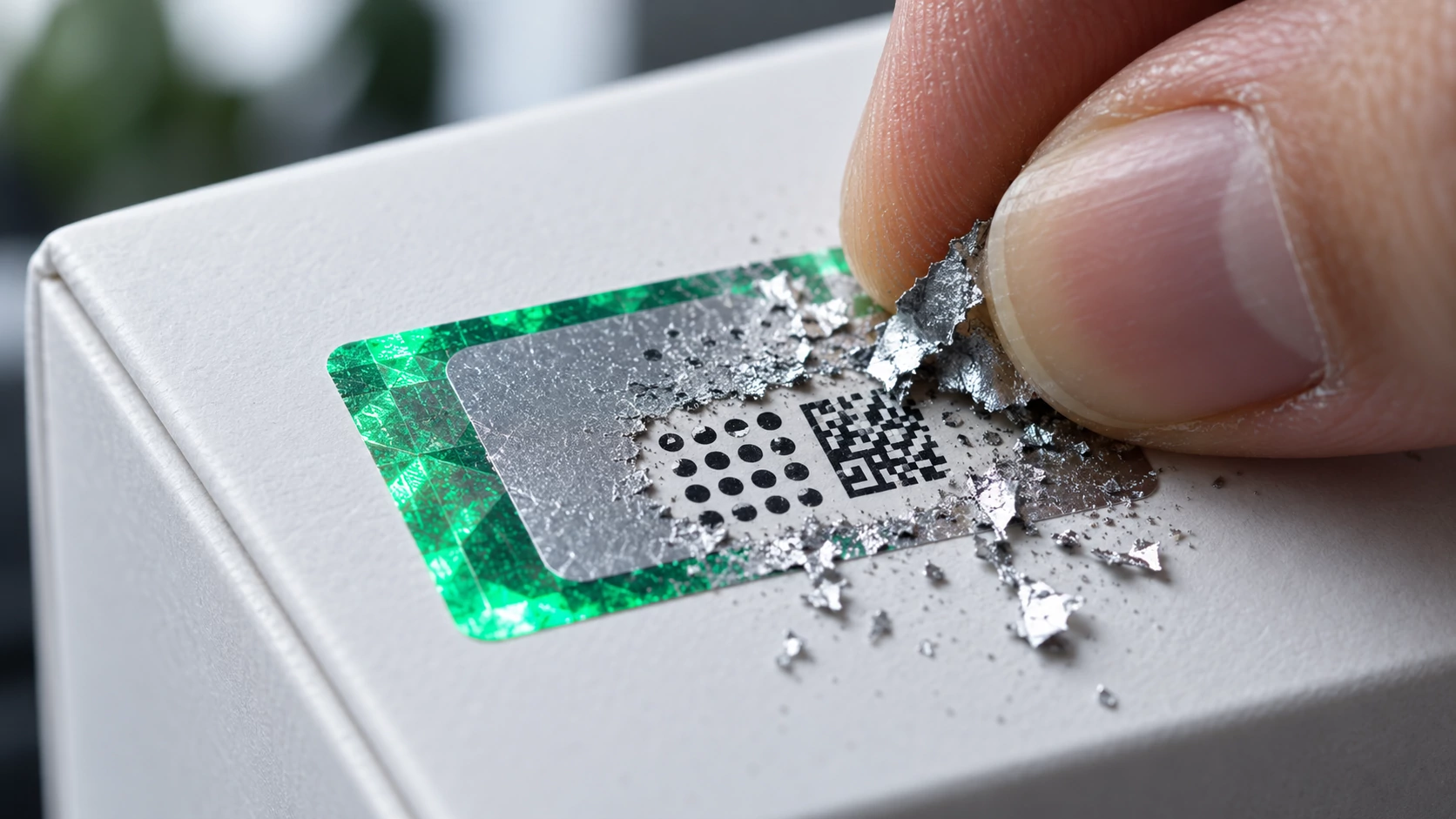
A holographic element can support a quick visual check. A serial number, QR code, or other unique identifier can connect the label to a record. Because a visible QR image can be copied, products with a material copying risk may need another layer such as a concealed credential, prior-use checking, and company review.
| Control need | Relevant label response | Question it does not answer alone |
|---|---|---|
| Reveal first opening | Break, tear, or visible tamper trace | Is the item identity valid? |
| Reveal label transfer | VOID residue or destructible construction | Was the same code used elsewhere? |
| Connect a pack to a record | Unique serial or authentication code | Has the package been opened? |
| Review copied-code risk | Concealed PIN and prior-use record | Was the physical surface damaged? |
Test the surface, adhesive, and environment together
A label that performs on coated board may behave very differently on a low-surface-energy plastic. Texture, curvature, varnish, dust, oil, and moisture can all change adhesion. Give the supplier the actual packaging material, coating, application point, and storage conditions instead of a generic description such as “plastic bottle.”
The Avery Dennison security labelling guide explains how surface energy, roughness, heat, and water exposure affect adhesive selection. It is not a universal product recommendation. It shows why a sample has to be qualified on the real surface and under the expected conditions.
Pressure-sensitive adhesives may need time to build their final bond. A peel test performed too early, without the supplier's stated dwell time, temperature, and cleaning process, can mislead the team. An Avery Dennison technical bulletin likewise notes that composition, texture, cleanliness, temperature, and dwell time influence the intended tamper response.
Placement is part of the security function
Even a capable material produces little useful evidence when it sits on a decorative panel that is untouched during opening. A closure label needs to cross the real opening path. A QR code needs a flat, readable area, while a scratch-off section should survive distribution but remain accessible to the customer.
Placement must be assessed with pack design, line handling, and user behaviour. The field guide to applying security labels covers surface, position, and production-line checks in more detail. During selection, the goal is to translate those operating conditions into a supplier specification.
Evaluate physical evidence and digital authentication separately
A physical tamper response addresses the question, “May this package have been opened?” A unique digital identity addresses, “Which item record matches this code, and has the credential been used before?” Neither capability automatically performs the other's job.
The xBarkod product authentication system supports a unique QR code and concealed scratch-off PIN for each product, prior-use checking, and company-dashboard visibility into authentication events. It does not replace the surface and placement decisions for the physical label; it adds item identity and event records to the operating process.
For a product exposed to code-copying risk, a concealed PIN alongside the visible QR makes it harder for someone without the physical pack to reproduce all verification information remotely. A warning still does not prove counterfeiting on its own. Product, time, location, prior use, and distribution context need company review.
How to request comparable supplier proposals
A request containing only dimensions and quantity invites proposals with different functions to appear in one price table. Include the threat definition, packaging surface, application point, handling method, expected tamper response, printing and code requirements, unwind direction, and acceptance tests in the same brief.
Use the hologram versus QR code comparison to separate the roles of visible and digital controls before asking for quotations. This approach compares control capabilities instead of supplier labels and makes it easier to explain which risk or process requirement creates a price difference.
- Has the supplier received a finished-pack sample and surface description?
- Is the expected response to opening, removal, or transfer documented?
- Is ownership of QR, serial, and PIN generation explicit?
- Are damaged, surplus, and unused labels assigned a defined status?
- Are roll format and orientation specified for manual or machine application?
- Are pilot approval and production-order approval separate decisions?
A pilot must test the whole process
A pilot should do more than display a label sample. Apply the sample to real packaging with the intended method, allow the specified dwell time, and run the critical storage, transport, opening, scanning, and PIN scenarios. Production reviews application; quality reviews physical response; technology teams review code state; support reviews customer messages.
Written acceptance criteria reduce subjective interpretation. Replace “it sticks well” with the visible result expected after an opening attempt, the devices and lighting in which a code should scan, the point at which the concealed area opens, and the message expected when a credential is checked again.
- Select representative finished packs from normal production.
- Apply labels with the intended line or manual process.
- Follow the supplier's bonding time and environmental conditions.
- Test normal use plus removal, opening, and copying scenarios.
- Observe the QR and PIN journey end to end with different users.
- Test rejection, invalidation, and closure of defective-label records.
- Approve results against criteria written before the trial.
Assign ownership across the label and code lifecycle
Procurement can source the label, but it cannot own every security outcome. Brand protection or quality can define threats and acceptance criteria; production can control application and waste; technology teams can own code generation and status; customer support can own verification messages and escalation of suspicious events.
Unique-code programmes also need reconciliation between labels ordered, labels printed, and identities activated on products. If damaged, missing, surplus, or unused labels have no recorded status, physical inventory and digital records drift apart. That gap weakens both operations and later event review.
Which selection mistakes create avoidable risk?
A common mistake is treating one visible feature as the entire security programme. A hologram does not create item history, a QR code does not show that a pack stayed closed, and a strong adhesive cannot make a badly placed label useful. Assess each layer according to its assigned job.
Another mistake is leaving customer experience until the end. A code that is hard to scan, a scratch panel without clear instructions, or a suspicious result without a support route can undermine a technically functional system. Label wording, symbols, and verification messages belong in the pilot.
- Selecting material from catalogue images alone
- Skipping tests on the final coating and surface
- Confusing physical tampering with digital code copying
- Comparing proposals with different scopes by unit price only
- Omitting records for waste, invalidation, and surplus labels
- Writing a customer warning as an automatic counterfeit verdict
Frequently Asked Questions about product security label selection
What is the most secure type of label?
There is no single most secure type for every product. The right construction depends on the threat model, surface, opening method, distribution conditions, and reviewer. A higher-risk product may justify both a physical tamper response and item-level digital authentication.
Should a brand choose a hologram or a QR code?
A hologram can support visual inspection, while a QR code can provide access to a digital record. They do different jobs. Decide which risk has priority—physical imitation, code copying, first opening, or event review—before selecting either layer.
Is a strong adhesive enough for security?
No. Adhesive must suit the surface and environment, but it does not by itself deliver the required tamper response, correct placement, or digital identity. Samples and a production-representative pilot should follow the material supplier's instructions.
Why might a visible QR code be insufficient?
A QR image can be photographed or printed on another surface. A unique code, concealed PIN, prior-use check, and link to the item record provide additional signals for reviewing that risk. Suspicious results still require company context.
Can a security label be added to existing packaging?
Many solutions can be added to existing cartons, bottles, or pouches, but suitability depends on surface, curve, coating, moisture, temperature, and the opening path. Do not assume compatibility without testing a finished-pack sample.
What should pilot acceptance criteria cover?
Criteria should cover application accuracy, adhesion, expected tamper evidence, code readability, PIN usability, item-code matching, reuse messaging, and defective-label handling. Assign an owner and a decision for failure against each criterion before testing begins.
Conclusion: Select from threat to evidence
A robust product security label decision begins with a risk statement, then brings physical response, surface compatibility, digital identity, user experience, and record ownership into one purchasing specification. Commit to production only after the complete process has worked on the real pack.
To evaluate how unique QR codes, concealed scratch-off PINs, prior-use checking, and dashboard visibility fit your selection plan, discuss your product authentication flow with xBarkod. Bring the product, a finished-pack sample, the priority risk, and draft pilot criteria so the scope can be assessed concretely.
More Articles

Product Authentication Dashboard Reports: A Manufacturer's Daily Review Workflow
Learn how manufacturers read product authentication dashboard reports and connect item, time, location, and suspicious activity to daily decisions.

How to Track Counterfeit Products Sold Online: A Brand Workflow
Learn how to track counterfeit products online by connecting listing, seller, controlled-purchase, packaging, item-authentication, and case evidence.

How to Control a Contract Manufacturer: A 9-Step Plan for Brands
Learn how to control a contract manufacturer through specifications, pilot runs, change approval, traceability, batch release, and product authentication.