
Cosmetic Product Authenticity Checks: What Does Each Signal Prove?
Checking cosmetic product authenticity takes more than scanning one barcode. A government registry can confirm product and company records, a batch code can identify a production group, packaging checks can reveal inconsistencies, and a brand-issued unique code can connect one physical pack to an item-level digital record. Each check answers a different question.
Consumers want confidence before using a product. Brands need something more operational: evidence that helps them review a copied pack, a reused code, or an unexpected channel event. The useful question is therefore not simply “did the barcode scan?” but “what exactly does this result establish?”
Start by defining the question behind the authenticity check
Authenticity is often used as a single label for several distinct concerns. A product appearing in an official registry is not the same as a pack looking consistent, a seller being authorised, or one item matching the brand’s own record. Separating those questions prevents a weak signal from creating false confidence.
- Can the product and responsible company be found in the official record?
- Do the package, label, and batch details agree with one another?
- Does this individual pack match a record created by the brand?
- Has the same code appeared at another time or place?
- Does the sale fit the brand’s expected distribution channel?
Think of these checks as an evidence ladder. A lower step such as a product-level record is useful, but it cannot distinguish every pack carrying that product code. A brand protection process should identify the right source for each question and define what happens when the signals conflict.
What can Turkey’s ÜTS record establish?
The official Turkish Product Tracking System states that users can search registered product and company information and report problems relating to cosmetics or medical devices. For a cosmetic check in Turkey, that makes ÜTS a sensible starting point for confirming the public product and company record.
Turkey’s Product Rules Database lists the Cosmetics Law and the Cosmetics Products Regulation dated 8 May 2023 among the core rules for this category. A registry and regulatory check belongs to the market-compliance layer of the evidence chain.
The practical limitation matters: finding a matching product record does not, by itself, prove that the physical pack in hand was made by the brand named in that record. A product-level barcode may appear on many legitimate packs and can also be copied onto an imitation. Item-level brand authentication addresses a different question.
Read barcode, batch, and packaging signals at the right level
The GS1 Global Traceability Standard distinguishes class, batch or lot, and individual instance identification. A class identifier distinguishes a product type, a batch identifier narrows it to a production group, and a serialised identifier can distinguish one instance. The business risk determines which level is appropriate.
| Check | Useful signal | What it cannot prove alone |
|---|---|---|
| ÜTS or official registry | Product and company record | The identity of the pack in hand |
| General barcode | Product-type match | Which pack has already been checked |
| Batch code | Connection to a production group | The history of one pack within the batch |
| Packaging review | Print, seal, and label consistency | A confirmed match to the brand’s digital record |
| Unique item code | Pack-level identity and use history | Formula safety or regulatory conformity |
Poor print, an unusual cap, a spelling error, or an unfamiliar batch format may justify closer review. Legitimate packaging can also change between production runs, however. Treat visual clues as triggers for verification, not as final proof, and compare them with current information from the brand’s official channel.
Why item-level authentication is a separate layer
Item-level authentication assigns a different digital identity to every physical pack. Two boxes of the same cosmetic product may share a retail barcode while appearing as separate records in the authentication system. The brand can associate each identifier with the relevant product and, where needed, its batch.
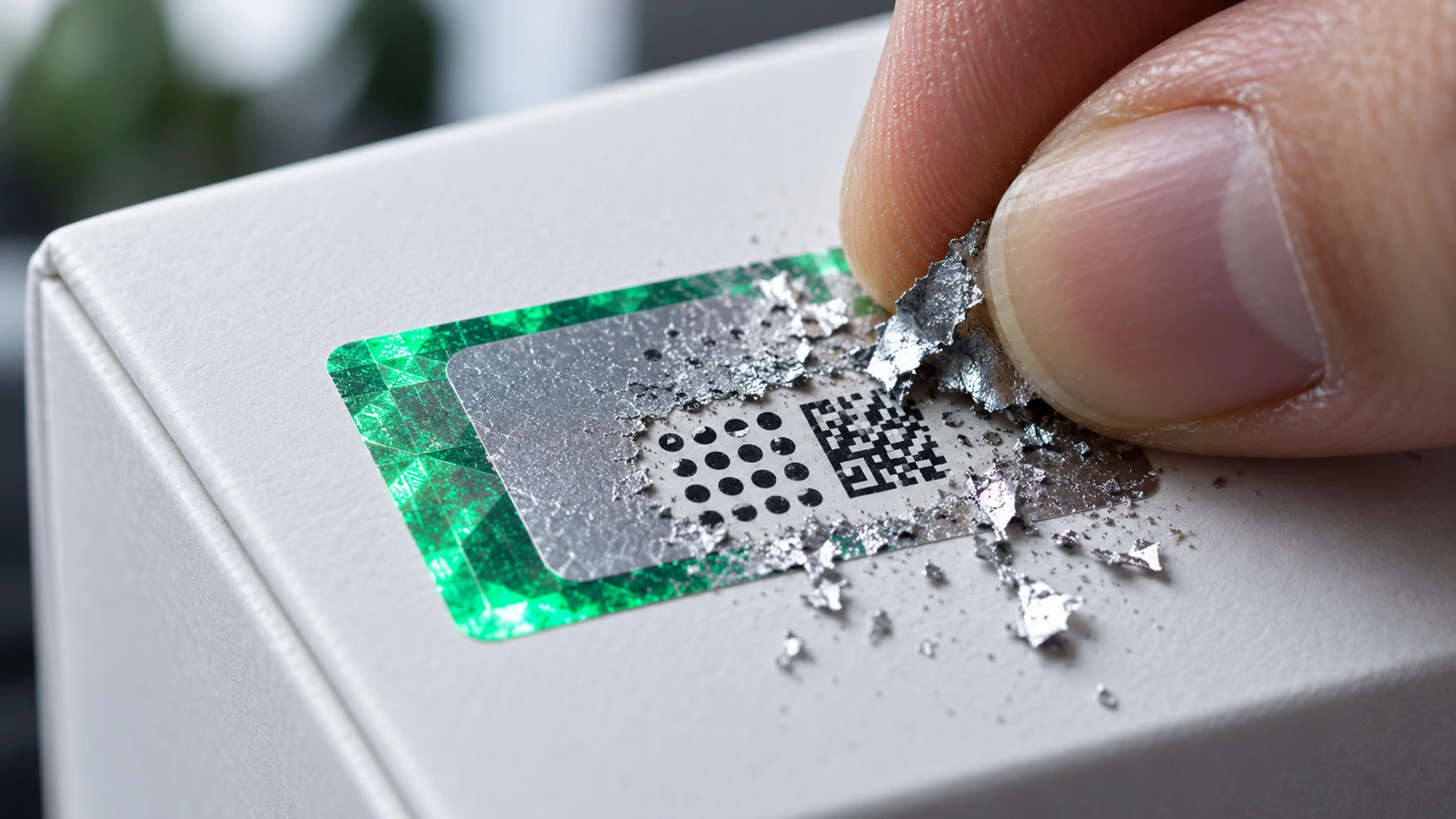
A visible QR image can be photographed and printed elsewhere. A concealed PIN that remains covered before purchase adds another check beyond that public carrier. The guide to copied QR codes explains why the visible code and its prior-use history should be assessed together.
A repeated verification is still a risk signal, not an automatic counterfeit verdict. The buyer may have checked the same pack twice, a support agent may have run a test, or a legitimate item may have moved through an unexpected channel. Review time, location, sales evidence, batch, and customer context before deciding.
Design a verification journey that consumers can finish
A useful journey does not send the buyer through a maze of unrelated search pages. Official records, physical packaging, and brand authentication should form clear, complementary steps. The result screen must explain the next action in plain language rather than expose only a technical status code.
- Check the seller, invoice, and delivery details.
- Search the product and company in the official ÜTS interface.
- Compare the package, batch, closure, and label with current brand information.
- If the brand offers a unique code, complete the QR and concealed-code journey.
- If the code does not match or has prior-use history, pause use and contact the brand through an official support channel.
Uncertain outcomes deserve as much design attention as successful ones. A code that is not found, has been seen before, or cannot be read requires a different explanation and support path. Turning every exception into the same severe warning can create unnecessary alarm and overwhelm customer service.
Data permissions are also part of trust. Explain why camera or location access is requested and decide what verification can still occur when a user declines location. A privacy choice should never be interpreted as evidence that the product is suspicious.
Connect the records the brand will need later
For the brand, verification does not end on the customer’s screen. Product master data, batch, unique code, label print run, application date, and code status need a traceable relationship. Surplus, damaged, rejected, or destroyed labels should have controlled statuses as well.
A verification event becomes useful when its outcome, time, prior-use status, and location where permission exists are available for review. Those details can be compared with shipments, authorised sellers, returns, and customer-support records. The goal is not to investigate every repeat, but to apply consistent rules that prioritise credible risk.
Decisions slow down when quality, customer service, and channel teams keep separate fragments of the same case. One case record should bring together pack images, invoice, batch, code history, communications, and closure reason. Record whether the outcome was a false alarm, an operational error, or a concern requiring further action.
Make the authentication layer work on cosmetic packaging
Cosmetics appear in small cartons, tubes, bottles, and jars with very different surfaces. A label may wrinkle on a curve, tear with the closure, touch a leaking product, or make the QR too small to read. The only reliable way to assess placement is on the finished pack under realistic handling conditions.
The security-label application guide covers surface choice, placement, adhesion, print readability, and line controls before full production. A cosmetic pilot should add transport, shelf exposure, opening, and normal use to those tests.
Keep the instruction for revealing the PIN and entering the code short and visible. Separate quality-control samples from codes intended for sale so internal scans do not distort customer events. Define a written rule for returned goods, including whether an exposed or previously checked code can re-enter saleable stock.
Where can xBarkod fit in this evidence model?
The xBarkod product authentication system describes a unique QR code and concealed scratch-off PIN for each product. It also states that customers can perform a verification while the company reviews events with time and location context in a dashboard, and that the security labels can be applied to existing packaging.
Assess those capabilities on one real cosmetic product family. Test the first scan, a repeated code, an incorrect entry, an unreadable label, transfer to customer support, and the resulting dashboard record in the same pilot. The objective is to confirm a workable evidence chain, not to claim that one control ends counterfeiting.
Ask for operational evidence during solution reviews
Do more than scan a demonstration QR code. Ask the provider to show how an identifier moves from creation and print control through pack application, customer verification, and case closure. A technology demo without the actual cosmetic pack, sales channel, and support process cannot represent daily use.
- How will we confirm that every saleable pack receives a different code?
- How are delivered, wasted, rejected, and destroyed labels reconciled?
- How does the dashboard distinguish first use from a repeat?
- What event data remains when a customer declines location access?
- How are uncertain results explained to consumers and brand teams?
- How are user permissions and data exports controlled?
- Which records prove that the pilot met its acceptance criteria?
Keep product registration, authenticity, and product safety in their proper places. A unique identifier may connect a physical pack with the brand’s record, but it does not replace evidence about formulation, manufacturing quality, storage, or regulatory conformity. A defensible process combines these layers without confusing their purposes.
Frequently Asked Questions about cosmetic authenticity checks
Does a cosmetic listing in ÜTS prove that the pack is genuine?
ÜTS helps confirm the product and company record. Because the same general product barcode may appear on many packs, that result alone does not establish who made the individual pack in hand. Review the seller, packaging, and any unique brand-issued code as separate signals.
Is a barcode lookup enough to authenticate a cosmetic product?
A general barcode usually identifies the product type. Distinguishing one pack and checking its prior use requires a serialised item-level identity. Read the barcode result together with the official record, batch details, packaging, and sales-channel evidence.
Can a batch code prove authenticity?
A batch code connects a product to a production group and supports traceability. Many packs can share that batch, so it does not uniquely identify one unit. An inconsistent format may prompt review, but the brand needs additional evidence before reaching a conclusion.
Can a QR code on cosmetic packaging be copied?
A visible QR image can be copied. A different code per item, a PIN concealed until purchase, and prior-use checking add layers against that risk. Any repeat event should still be reviewed in context rather than presented as a final verdict.
Does authenticity verification prove that a cosmetic is safe?
No. Authentication is designed to connect a pack with a brand record. Product safety depends on separate evidence concerning formulation, manufacturing, assessment, storage, and applicable rules. The two processes can support one another but are not interchangeable.
Where should a cosmetic brand start with authentication?
Start with one product family and its real finished packaging. Test code creation, label application, first and repeated verification, dashboard records, consumer messages, and case closure together. Expand only when the pilot produces evidence that the operating model works.
Conclusion: Build trust by respecting the limits of every signal
The strongest cosmetic authenticity check does not place too much weight on one mark. It combines official records, seller evidence, packaging, batch information, and item-level authentication. Consumers should understand what they checked, while the brand should know who reviews an exception and which evidence closes it.
Begin by identifying which products require pack-level separation beyond a general barcode. Then compare the proposed workflow with the product authentication system guide and run a verifiable pilot on the actual cosmetic package.
More Articles

Product Authentication for SMEs: A Practical Starting Plan for Small Brands
Learn how SMEs can scope product authentication, control costs, test labels, run a practical pilot, and build a manageable daily review process well.

Geographic Product Authentication Tracking: Turning Location Signals into Risk Decisions
Learn how to combine location, time, and channel context in product authentication, reduce false alerts, and build an evidence-based geographic tracking pilot.
QR Code and Scratch-Off PIN System: An Implementation Guide for Brands
Learn how a QR code and scratch-off PIN system works, where implementation can fail, what to ask vendors, and how to define evidence-based pilot acceptance.